
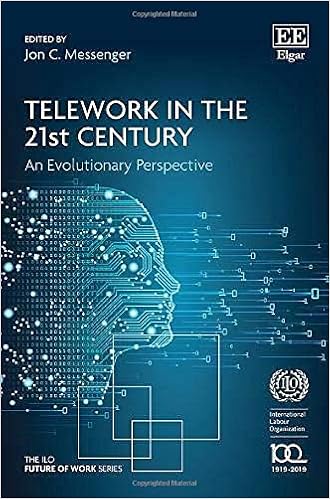
 The following telecommuting/mobile work/remote work statistics were compiled by Global Workplace Analytics, a research-based consulting firm that has been helping employers optimize flexible and distributed workplace strategies for more than fifteen years. Kate Lister is president of Global Workplace Analytics and is considered to be one of the leading global authorities on these topics. She has written or co-authored five business books including the U.S. chapter of “Telework in the 21st Century” (Edward Elgar, 2019), a multi-country peer-reviewed study on remote work. Her perspectives on how COVID-19 will change the way people work have appeared in the New York Times, Washington Post, Wall Street Journal, Newsweek, and dozens of other respected news outlets. In July of 2020, she was one of only three witnesses invited to testify before a U.S. Senate committee on the expansion of telework in government post-COVID-19.
Note to Reporters—June 2021:
Kate Lister is happy to share additional details about the latest remote work statistics and trends and to provide insights from her research and client work regarding:
• How many employees are likely to work remotely or in a hybrid fashion after the pandemic is over?
• Results from the 2020 Global COVID-19 Work-from-Home Experience Survey
• Results from the 2020 and 2021 State of Remote Work Survey
• Best practices for return-to-the-office hybrid workplace strategies
• What large organizations are doing in terms of telecommuting, remote work, and hybrid-remote work
• Topics including employee surveillance/monitoring, tax and legal implications with an interstate or multi-country workforce, difficulties in working from home, managing work-life conflict, employee stress, and more
• The potential environmental impact of telecommuting and hybrid-remote working
• Details behind the estimate that employers can save an average of $11k/year for each halftime remote worker
• What governments need to do to encourage more remote work and why they should do it
Click here for our latest press releases on COVID-19 and work-from-home.
If you are on deadline call 760-703-0377 (during a decent hour, Pacific Time), otherwise please email Kate@GlobalWorkplaceAnalytics.com).
Telecommuting Trend Data (updated June 22, 2021)
Note: You do not need permission to use this data provided you cite GlobalWorkplaceAnalytics.com as the source. A link would be appreciated and we do say thank you by making sure our social network sees your work.
Below are the latest available statistics on the work-at-home/telework population in the U.S. based on our analysis of the 2005-2019 American Community Survey (ACS, a U.S. Census Bureau product). New ACS numbers, for the prior year, are typically released each Fall but due to the pandemic, the government may not have data for 2020.
The American Community Survey derives its data on the work-at-home population from the single question: What was your primary means of transportation to work during the survey week? “Worked at home” is one of the choices. Therefore, all we know about this population is that they worked at home half-time or more during the previous week.
Though often used interchangeably, ‘telework’ is defined as the substitution of technology for travel, while ‘telecommuting’ is more narrowly defined as the substitution of technology for commuter travel. Thus if someone takes work home after being at the office, it’s considered telework but not telecommuting. If someone works at home instead of driving to an office they are telecommuting but not necessarily teleworking. Both terms were coined by Jack Nilles in the 1970s.
Important point: many people and organizations are moving away from both the term telework and telecommuting in favor of remote work, work-from-home, distributed work, mobile work, smart working (UK). The term “hybrid-remote”, meaning a mix of onsite and remote work, is gaining in popularity as is “work anywhere”, which means allowing employees to work wherever they want.
More important point: If you’re confused by all the conflicting numbers you read about telework, join the club. We explain the problem and try to offer a clearer view here.
Most important point: Unless noted, the numbers below do not include the self-employed.
Key Telecommuting Data and Trends
Statistics on how many employees telecommuted before/during the Pandemic?
• 69% of U.S. employees worked remotely at the peak of the pandemic [State of the Remote Workforce, Global Workplace Analytics and OwlLabs, 2020 – based on 2,500 survey responses from full-time workers]
• 5.7 million employees (4.1% of the U.S. employee workforce) telecommuted half-time or more before the pandemic [Global Workplace Analytics’ analysis of 2019 American Community Service (ACS) data]
• Regular telecommuting grew 216% between 2005 and 2019, more than 11 times faster than the rest of the workforce (which grew 20%) and 54 times faster than the self-employed population (which grew by 4%) [Global Workplace Analytics’ analysis of ACS data]
Statistics about how many employees could work remotely
• 56% of employees have a job where at least some of what they do could be done remotely [Global Workplace Analytics]
• 62% of employees say they could work remotely [Citrix 2019 poll]
• Prior to the pandemic, the majority of office space utilization surveys showed people were not at their desks 50-60% of the time; they were already mobile
Statistics about how many employees want to telecommute
• 82% of U.S. employees want to work remotely at least once a week when the pandemic is over. On average, they would prefer to do so half of the time. Only 8% do not want to work from home at any frequency. Nineteen percent said they would like to telecommute full-time. The balance would prefer to work a hybrid-remote schedule. [Global Work From Home Experience Survey, Global Workplace Analytics & Iometrics, 2020 – based on 1,100 U.S. respondents]
• If they were not allowed to work remotely after the pandemic: 54% of U.S. employees say they would stay with their employer but be less willing to go the extra mile and 46% would look for another job [State of Remote Work 2020, Owl Labs]
• Only 12% of federal employees say they would not want to work from home at least some of the time [Federal Employee Viewpoint Survey 2018]
• 35% of employees would change jobs for the opportunity to work remotely full time (47% of Millennials and 31% of boomers); 37% would do so to work remotely some of the time (50% of Millennials and 33% of Boomers) [State of the American Workforce, Gallup, 2016]
• Flexibility is one of the highest-ranked benefits by Millennials, even higher than student loans or tuition reimbursement. It ranked high for Boomers too although the percentages were 15-20 points lower. [State of the American Workforce, Gallup, 2017]
• More than a third of workers would take a pay cut of up to 5% in exchange for the option to work remotely at least some of the time; a quarter would take a 10% pay cut; 20% would take an even greater cut. [State of Remote Work 2019, Owl Labs]
What is the demographic data on employees who work remotely?
• A typical telecommuter is college-educated, 45 years old or older, and earns an annual salary of $58,000 while working for a company with more than 100 employees. 75% of employees who work from home earn over $65,000 per year, putting them in the upper 80th percentile of all employees–home or office-based. [Global Workplace Analytics’ special analysis of 2016 ACS data]
• The chart below shows the percentage of people who work-at-home by industry. [Global Workplace Analytics’ special analysis of 2016 ACS data]

• Using home as a ‘reasonable accommodation’ per the Americans with Disabilities Act, 463,000 disabled employees regularly work from home (7.1% of the disabled).
Statistics on employers that offered remote work before the pandemic?
• Forty percent more U.S. employers offered flexible workplace options than did five years ago. But only 7% make it available to most or all of their employees. [Global Workplace Analytics’ analysis of BLS data, 2019]
• 69% of employers offer remote work on an ad hoc basis to at least some employees, 42% offer it part-time, 27% offer it full time [SHRM 2019 Employee Benefits Survey]
• Larger companies are most likely to offer telecommuting options to most of their employees. [Global Workplace Analytics’ analysis of 2017 ACS data]
• New England and Mid-Atlantic region employers are the most likely to offer telecommuting options. [Global Workplace Analytics’ analysis of 2017 ACS data]
• Full-time employees are four times more likely to have remote work options than part-time workers. [Global Workplace Analytics’ analysis of 2017 ACS data]
• Non-union workers are twice as likely to have access to telecommuting, but union access is growing rapidly. [Global Workplace Analytics’ analysis of 2017 ACS data]
How do employers benefit from remote work?
Based on conservative assumptions, Global Workplace Analytics’ estimates a typical U.S. employer can save an average of $11,000 per half-time telecommuter per year. The primary savings are the result of increased productivity, lower real estate costs, reduced absenteeism and turnover, and better disaster preparedness. Employers can calculate their own potential savings using our free Telework Savings Calculator™ which a report to Congress by the U.S. Office of Management and Budget referred to as “comprehensive and based on solid research.”

Click here for additional benefits of remote work for employers as well as the potential drawback.
How do employees benefit from remote work?
We estimate that employees save between $600 and $6,000 per year by working at home half the time. Those savings are primarily due to reduced costs for travel, parking, and food. They are net of additional energy costs and home food costs.
In terms of time, a half-time telecommuter saves the equivalent of 11 workdays per year in time they would have otherwise spent commuting. Extreme commuters save more than three times that.
Click here for additional benefits for employees who work at home.
How does society and the environment benefit from remote work?
Eliminating or reducing commuter travel is the easiest and most effective way for a company or individual to reduce their carbon footprint. Based on our estimates, if those who have a work-from-home compatible job and a desire to work remotely did so just half the time, the greenhouse gas reduction would be the equivalent to taking the entire New York State workforce off the road. These estimates assume a 75% reduction in driving on telework days.
Click here for additional benefits of remote work for the community and environment.
Still hungry for the latest remote work and workplace trend data?

Additional Information for Reporters
We are constantly updating our database of over 6,000 documents on telework, activity-based work, co-working, remote work, work-from-home, and other emerging workplace strategies.

Reporters, feel free to call or email for the latest data or for additional information about:
• Work-from-home demographics (gender, age, education, private/public sector, industry, income, etc.)
• Global and U.S. drivers of telework
• Best practices for work-at-home strategies
• Advantages and disadvantages of telework for employers/employees
• Industry contacts/potential interviewees (employers/employees)
• Workplace flexibility and its impact on employee well-being
• Other future of work trends
Kate Lister, president of Global Workplace Analytics, can be reached at kate-at-globalworkplaceanalytics.com or 760-703-0377 (Pacific Time).
A note to students:
TL;DR – We will not do your homework for you.
We do not take kindly to being interrupted with requests from students who have not bothered to do their own research or tried to find what they need by combing this site and downloading our free resources.
Telling us how urgently you need the information because your paper or thesis is due tomorrow will not help your cause, nor will incomplete or incoherent requests. You can assume we will not respond because, as the saying goes, a lack of planning on your part does not constitute an emergency on our part.
But, if you’ve tried your best and still can’t find what you need, you’re welcome to write to us, tell us who you are, what you’re working on, what you want (not, for example, “Can you send me citations for all the statistics on your website?”), and why you’re asking. When we can find time between client work (in other words people who pay us to help), we’ll get back to you. No really, we will.
“Please” and “thank you,” will go a long way toward helping your cause.
Sorry if we’re grouchy, but you ought to see some of the stuff we get from lazy students…
About Global Workplace Analytics and Kate Lister
Kate Lister is a recognized thought leader on the future of work. She is president of Global Workplace Analytics (GWA) an 18-year-old research and consulting firm that helps employers understand and prepare for the future of work. GWA’s expertise is focused on workplace, workforce, technology, and other trends that are changing the who, what, when, where, and how of work.
Working with some of the world’s most respected brands, GWA helps make the ‘people, planet, and profit’ business case for workplace change and collaborates to publish a wide range of original and secondary research. In the spirit of sharing, GWA’s many calculators and much of its research is available for free on this website.
GWA’s proprietary tools include:
• An extensive digital library with over 6,000 research reports, case studies, and other content related to the technologies, trends, and scientific understandings that are transforming the way people work
• A variety of customizable web-based and mobile calculators that estimate the ROI of workplace change
• Model business cases for a wide range of workplace strategies and stakeholders
• Templates for collecting pre- and post-strategy measures of success
GWA’s research has been cited by hundreds of publications including the Harvard Business Review, New York Times, Wall Street Journal, Washington Post, and many others.

Kate is a member of the strategic advisory board and leadership team of Workplace Evolutionaries (WE), a global group of leading workplace thinkers and doers who are dedicated to “changing the world one workplace at a time.”
She has written or co-authored six books and hundreds of articles for major media outlets. Her most recent book contribution was as the writer of the U.S. chapter of a peer-reviewed examination of global remote work trends called “Telework in the 21st Century” (Edward Elgar, 2019).
Kate lives in San Diego CA with her husband and three dogs. She teases that she charges clients extra if she has to travel anywhere that’s too cold, too hot, too humid, or too buggy. She offers a discount for fun companies and cool gigs. For more details, please visit the About and What We Do pages.
Kate is available for interviews and will happily help reporters identify additional resources. She can be reached at 760-703-0377 (Pacific Time) or Kate@GlobalWorkplaceAnalytics.com.
